Recovery Technology - List of Manufacturers, Suppliers, Companies and Products | IPROS

Recovery Technology Product List

1~5 item / All 5 items

Displayed results

Tohoku Univ. Technolog: Technology for metal resources recovery from solid waste:T24-100

Environmentally friendly technology using recyclable chelating agents

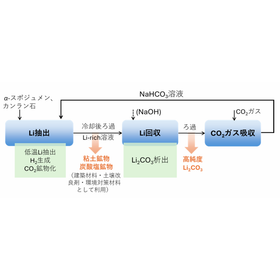
 Solid wastes, including industrial wastes, rocks, and polluted soils, contain various elements such as hazardous heavy metals and rare earth metals. Conventionally, strong acids have been used as extractants to enhance the leaching of these metal ions, which are subsequently recovered using electrochemical methods. However, these methods have environmental and economic problems because they consume a large amount of chemicals and electricity. The inventors have successfully developed a process that uses a recyclable solution containing an environmentally friendly chelating agent as the extractant for metal ions and anions extraction from solid wastes, which are efficiently recovered from the extractant, enabling the regeneration and reuse of the extraction solution.  The present invention is expected to be applied to the removal of toxic ions from polluted soil. It is also expected to be used for the collection of resources such as rare earths from minerals. Furthermore, it can be combined with CO2 mineralization technology using solid wastes. (E.G., Patent No. 7345791)

  • others
  • Recovery Technology

Added to bookmarks

Bookmarks list

Bookmark has been removed

Bookmarks list

You can't add any more bookmarks

By registering as a member, you can increase the number of bookmarks you can save and organize them with labels.

Free membership registration

[Seminar] Development History of Mitsubishi Heavy Industries, Ltd. Exhaust Gas CO2 Recovery Technology

~Track record of delivering 16 top commercial plants in the industry~

We will hold a seminar titled "Development History of Mitsubishi Heavy Industries, Ltd.'s CO2 Recovery Technology from Exhaust Gas." CO2 recovery technology is gaining attention as a significant measure to prevent global warming. Mitsubishi Heavy Industries, Ltd. began developing CO2 recovery technology from exhaust gas in collaboration with Kansai Electric Power Co., Inc. in 1990, ahead of other companies as part of its environmental initiatives. Over the past 30 years, we have continuously pursued technology development, leading to the delivery of 16 commercial units, making us a global industry leader. In this presentation, we will outline the development history of our CO2 recovery technology up to the present and the history of its commercialization, introduce the latest project examples, and discuss our initiatives. Furthermore, we will elaborate on the future prospects of our technology in the pursuit of a carbon-neutral society. 【Seminar Details】 ■ Date and Time: September 20 (Friday) 13:30 - 15:30 (Doors open at 13:00) ■ Venue: JPI Conference Square ■ Address: 5-2-32 Minamiazabu, Minato-ku, Tokyo, Kowa Hiroo Building ■ Speaker: Mitsubishi Heavy Industries, Ltd. GX Segment, Decarbonization Business Promotion Department Technical Director, Chief Project Supervisor Mr. Takashi Kamijo *For more details, please refer to the PDF document or feel free to contact us.

  • others
  • Recovery Technology

Added to bookmarks

Bookmarks list

Bookmark has been removed

Bookmarks list

You can't add any more bookmarks

By registering as a member, you can increase the number of bookmarks you can save and organize them with labels.

Free membership registration

Introduction to the Volatile Chloride Method

Non-ferrous metals with a lowered boiling point are volatilized and removed in areas above 1,000°C within the rotary kiln.

The "chloride volatilization method" is a technique for removing non-ferrous metals by adding calcium chloride to a powder containing non-ferrous metal oxides (with iron oxide as the main component) to form pellets, and then subjecting them to heat treatment in a rotary kiln. This method separates and recovers non-ferrous metals from raw materials that contain both iron and non-ferrous metals, recycling each as ironmaking raw materials and non-ferrous refining raw materials. 【Features】 ■ Volatile removal of non-ferrous metals ■ An important process in resource recycling *For more details, please refer to the PDF document or feel free to contact us.

  • Other resource recycling
  • Recovery Technology

Added to bookmarks

Bookmarks list

Bookmark has been removed

Bookmarks list

You can't add any more bookmarks

By registering as a member, you can increase the number of bookmarks you can save and organize them with labels.

Free membership registration

Tohoku Univ. Technology:Recycling of Lithium-ion Battery Cathode Materials through Hydrothermal Reaction: T18-116

Expected to reduce environmental load, avoid corrosion of equipment, and shorten reaction time

 As a method for recovering valuable metals from spent LIB cathode materials, a wet scouring method is mainly used in which various metals are separated using a back extraction method using an organic solvent after leaching metal components using an acid. However, sulfuric acid and nitric acid, which are used as acids, cause a large environmental load because toxic gases are generated, and hydrogen peroxide, which is used as a reducing agent, has problems such as explosiveness and carcinogenicity. In a system without adding hydrogen peroxide, the recovery rate of metal ions decreases, so that improvement of the process is required.   In order to solve the above problems, the inventors focused on a hydrothermal reaction and examined reaction conditions such as the type of acid. As a result, they succeeded in almost completely leaching metals without using strong acids and reducing agents by using organic acids such as citric acid and the amino acid glycine. The effects of continuous operation, shortening of reaction time, and avoiding corrosion of equipment can be expected by the present invention. 

  • others
  • Recovery Technology

Added to bookmarks

Bookmarks list

Bookmark has been removed

Bookmarks list

You can't add any more bookmarks

By registering as a member, you can increase the number of bookmarks you can save and organize them with labels.

Free membership registration

Tohoku Univ. Technology:Carbon recovery from dry smelting flue gases:T21-205

Carbon recovery from CO2 and CO containing gas Use as raw material for ironmaking

The steel industry, which emits the largest amount of carbon dioxide (CO2), is required to reduce its CO2 emissions as soon as possible.  A process for recovering and recycling solid carbon from gases containing CO2 and carbon monoxide (CO) is known. This process uses water gas shift reaction (CO2+H2→CO+H2O) and carbon deposition reaction (2CO→C+CO2, CO+H2→C+H2O). However, there has been concern that the precipitated carbon is fine and difficult to recover.  This invention enables carbon recovery from CO2 and CO in gas by using porous fibrous iron (iron whisker) as a carbon deposition site. Furthermore, iron raw materials containing carbon could be used directly in the ironmaking process. This may lead to the carbon cycle process in the ironmaking process.

  • others
  • Recovery Technology

Added to bookmarks

Bookmarks list

Bookmark has been removed

Bookmarks list

You can't add any more bookmarks

By registering as a member, you can increase the number of bookmarks you can save and organize them with labels.

Free membership registration